Friday, December 1, 2017

Parshat Vayishlach: Choosing Our Words With Care


In this weeks parsha, Yaakov travels with his family back to his birthplace.
Yaakov decided to send messengers to speak to Eisav and give him gifts. But when Eisav heard that Yaakov was coming, he gathered 400 soldiers and planned to attack him.

When Yaakov heard that Esav was coming to attack him, he decided to problem solve to find a solution. He came up with a few different ways to deal with the challenge.

 1. He davened 2. He split his family,servants and belongings into 2 camps. 3. He sent gifts to Eisav to try and appease him.

*In our class, we also tried to problem solve, can you think of more than one way to do it?*


Thank G-d when they finally met, they were able to make peace... kind of...
.- ask your child for more details!!!

Eisav asked to travel with Yakov, but Yakov didnt want Esav to change his mind, so he chose his words carefully and said " I am very slow and I have a lot of people with me, you go on ahead," That way he wouldn't offend Eisav.

We practice this every day in school! Sometimes a friend may have a snack or lunch that I don't like!

* Ask your child. What should you say?

Even though he had already split his family, when he realized he had left a few jars behind, Yakov went back to get them.


We practiced taking care of our belongings. When markers rolled under the table outside, Menucha made sure to pick them up and put the lids back on so they wouldn't dry out.

Below she proudly displays her Kever Rochel.


Rachel passed away giving birth to Binyomin and was buried by the road called Beis Lechem. Hashem told Yakov to bury Rachel there, so that when the Jewish people would be taken into Golus (exile) they will pass by her kever (burial place). Then Rochel will cry to Hashem to have mercy on her children, and Hashem will promise that they will come back to Eretz Yisroel in her merit.


Getting Ready For Chanukah


In the beginning of this week we watched a video about how olive oil is made. It was so interesting to see how the olives were crushed and turned into oil.

"Can we watch it again Morah Avigayil!!"- Everyone, the entire week


We began our Chanukah unit by learning about the Bais Hamikdash- Hashem's home!

Elizabeth, Menucha and Levi Yitzchak set up a house with furniture to make it comfortable.

What makes Hashem comfortable in a house?

(Torah and Mitzvot)


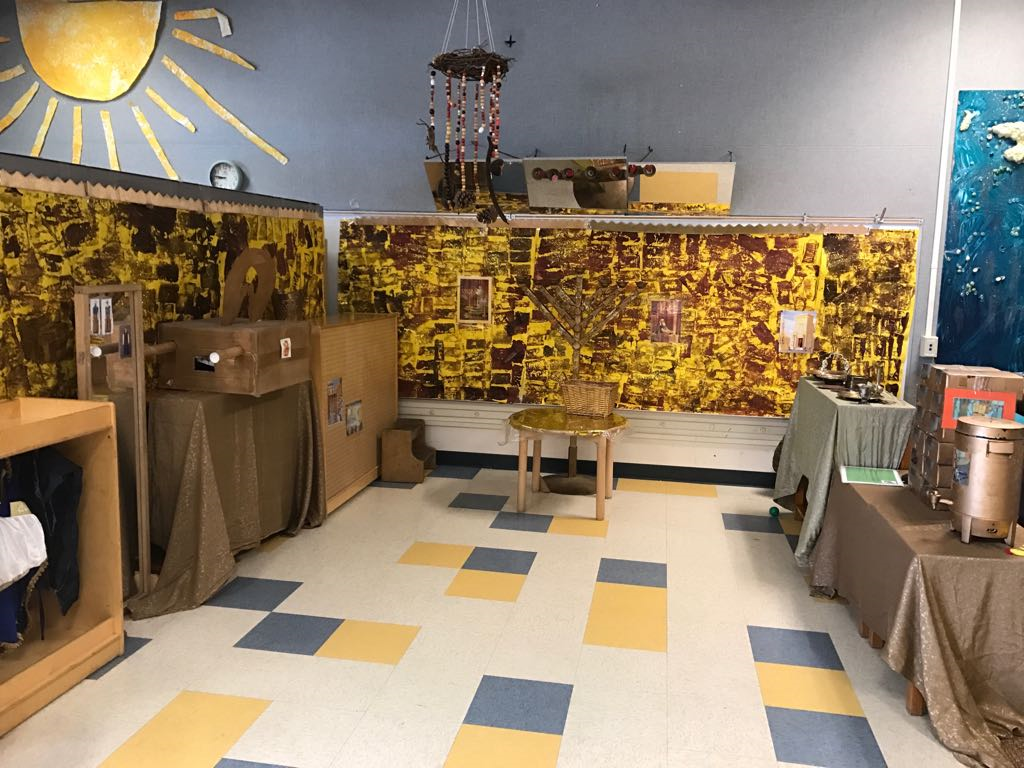
The Gan Class graciously invited us to visit their Bais Hamikdash!

The Bais Hamikdash was Hashem's House, the ultimate place to learn Torah and do Mitzvos.


We saw the golden Menorah and the Aron Kodesh- where the Torah was kept. We made sure to be respectful and leave everything the way we found it.

Language Arts

We practiced putting words together and separating the sounds of each letter.

We call it ungluing and gluing.

For example: "dd" "o" "tt" - unglued

d+o+t = dot

Levi Yitzchak wrote down the glued words on his whiteboard


Morah Davina and Yisroel had a lot of fun working on fine motor skills.

We also practiced letter recognition and words in this way.


Social Studies Snapshot

Muka sorts different items into envelopes labeled Needs and Wants.

Getting bigger means we can really understand the difference.


We are growing sprouts!!Trying our Sprouted Beans
from our Science Corner!


Day 1- They were hard and didnt taste very good.

Day 2- They were soft, some friends liked the taste, other friends gave their beans away to the garbage can

Day 3- We can see sprouts coming out of our beans!


We are also trying to grow Avocado plants, but that is going to take much longer.

Muka can hardly wait!

Mathematics- If it Can't Even, Then it's Odd


Even if a number is huge, you can tell if it's even or odd by the last digit.


The biggest number we looked at was 2,097!!

The last digit is 7.

*Ask your child if it's even or odd?

We use the buddy system to count it out.

Max places a number on the chart, made.

An even number has a buddy, but an odd number is all alone.


We started learning about different 3D shapes

We knew one shape right away! The cone!

It looks like an ice cream cone.


A special 2000 year old home!

  Chanuka Unit

As a foundation to the Chanuka story we explored what life was like for the Jewish people in Israel before the harsh challenges they faced from king Antiyochus.
Life was beautiful, inspiring and filled with awe especially in the Holy Temple. People from all over came to witness Hashem's miracles and the beauty of all the keilim (vessels)
We are still waiting for the third and final Temple to be built and since we don't have that experience yet we wanted to make as realistic as we could for our class.

What was the Beis Hamikdash? (Temple)

The Beis Hamikdash was Hashem's special home for his glory to be revealed in this world. 
We started off by showing some of our friends homes and watching their reactions when they recognized their own. We love our home, we feel comfortable and can be ourselves.

We offered different ways to express their love for their home and family.

Some friends documented on the easel for their friends to learn more about their own home.


Mendel and Ari painting their homes.


Dovi and Evan using magna tiles and tape to create their home. 
Faiga using water and chalk outdoors.


Beis Hamikdash Center

Building on the children's innate love for their home and understanding of what a "home" is the children were now ready to learn more about Hashem's home. 


The Kohanim (priests) had a lot of important jobs in the Beis Hamikdash. One of which was to light up the golden Menorah everyday! We placed pictures on the mirror of the special clothing they would wear and costumes to get into role. 

Bela Riva noticing the Koheins special hat just like she was wearing.

 
Moshe role playing the  Kohen washing his hands by the Kiyor (wash basin) before working in the Beis Hamikdash.


The Menorah

Every day the special golden Menorah was lit in the Beis Hamikdash for all to see. How did they light it and what did they use?
After telling the children olive oil we asked "Where did they get it from?". The reply was unanimous "At the store!". 

This was a great opportunity to learn about the long process the Jewish people had to go through to make the oil for the Menorah and will help them understand the miracle of Chanuka. 

Dovi brought in branches with olives on it from his backyard!
 Learning the process through picture sequencing and Menachem showing us crushing the olives to create olive oil. 


 How much oil can we get?
 After all of our friends helped crush many olives and Saige helped squeeze the drops of oil into a jug  the children realized how little was coming out! 
"Wow! They needed a lot of olives and worked SO hard!"

 Lighting the Menorah was a highlight this week!

The Jugs had special seals on them just like in the real Beis Hamikdash.


Giving Bikurim

There was a special Mitzvah called "Bikurim" that the Jewish people would observe during the Beis Hamikdash times. They brought the first fruits from their trees, to give as a gift to the Kohanim.
We placed fruits on a tree for the children to pick. 
 Bela Riva role playing how they would balance it on their heads on the way to the Beis Hamikdash.
After mina lit the Menorah her friends brought a basket of fruit to say 'thank you'!

Saige and Ari 'tasting' the Lechem hapanim which was the 12 challahs the Kohanim ate from as well.


The Aron Kodesh was the holiest of all vessels. It contained the Torah we got by Mount Sinai.


While we sang Torah songs during circle time, Saige and Evan brought the Aron Kodesh !


It has been such a special week talking about our Jewish History and the gift of the holy Beis Hamkidash as well as looking forward to the next and final one!!
Each good deed we do helps bring the Beis Hamikdash.

Watch the children dance in our center asking Hashem to send the REAL one!


Friday, November 17, 2017

Which voice will you listen to? KINDERGARTEN class!

Parshat Toldot


In this weeks parsha we learned the story Yitzchak and Rivka being blessed with the birth of twin boys Yakov and Eisav. They were very different right from the start. Eisav the firstborn was very red and hairy, and Yakov was not. They also made very different choices in how they lived their life. Yakov loved learning Torah and doing Mitzvos, Eisav loved playing in the fields and hunting. Once Eisav grew up, Hashem caused Yitzchak to lose his eyesight so then he wouldn't be able to see the bad things Eisav was doing. 

The Torah teaches that Yakov and Eisav reflect the 2 voices we have inside each of us. Our job us to listen to these voices, and figure out which voice is telling us what!


Which voice will you listen to?

We made Yakov and Eisav bracelets to remind us which voice to follow.

   
All of our friends made sure to act like Yakov . 
When Morah saw a student acting like Yakov they got a sticker to add to their bracelet.


Our words are powerful!

Hashem didnt want to say Lashon Hara (bad language/gossip) about Eisav to Yitzchak so Hashem made Yitzchak become blind. This teaches us an important lesson on how we should judge people.

 Morah Davina showed us this picture of two plants.
Every day the owners would speak to them, one nicely and one not nicely.

There is such a big difference between them!

We learnt how Yitzchak dug wells and the children got so excited they decided to dig a well of their own !


Alef Bais Capit 

This week we began putting the sounds of the letters together to actually READ WORDS!

Each sound or letter is a building block of reading. So we can already sound out a couple words!

Interactive Learning!

This sweet video showcases learning a new letter. 
The combination of song, visual, reading and writing, make each new letter exciting for all our different types of learners.


Playing games help the new sound really be processed and sink in.


We also started to focus on hebrew names this week. 
Yisroel practices the letters of his name on the whiteboard.


At the end of the day, we went around and each said our favorite thing we learned that day.
Elizabeth said, " I love learning to read!"

Scientists at Work

This week we learned about Producers and Consumers.
Plants are called producers. This is because they produce their own food! They do this by using light energy from the sun, and water from the soil to produce food. Animals are called consumers. This is because they cannot make their own food. So they need to consume (eat) plants or animals.

We experimented on some producers in our classroom!


We filled up three vases with water and added a different food coloring to each one.  


We then hypothesized what would happen to the flowers in each of the different vases of water.
Then we waited ...
Lo and Behold, the flowers started changing colors!
 It was using the water and changing colors! 


Fish for our classroom


Morah Davina surprised us with five little fish. Our kinder are so excited to learn how to take care of the fish! Through feeding the fish the children experienced consumers.

Thank you Morah Davina!


Let us know if you would like to contribute by buying food or filters.

Math Mastery

Elizabeth and Levi Yitzchak put the right amount of buttons on the shirt.


We all worked together to make a smiley face,
 then we counted how many buttons were in it.
42!


Number Bingo assists in number recognition.
Max had three 11s!"


Muka and Elizabeth show us the different ways to make 4